


Tower Training Explained: Elevating Your Pilates Experience
- Adicator Digital Marketing Agency
- 46 minutes ago
- 4 min read
In the world of professional Pilates, practitioners often start their journey on the Mat or the Reformer. However, there is a third pillar of training that many enthusiasts consider the "secret weapon" for achieving a truly resilient and flexible body: The Tower.
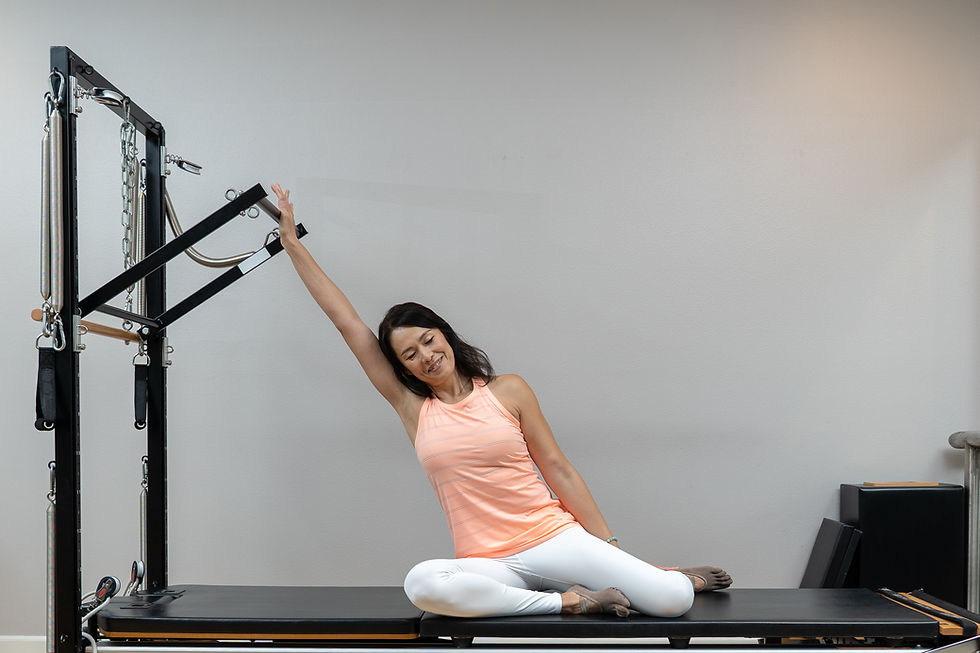
At Momax Pilates at Roecklplatz in Munich, we integrate Tower Training to provide our clients with a more expansive, three-dimensional movement experience. While the Reformer uses a sliding carriage to create resistance, the Tower utilizes a vertical frame equipped with springs, bars, and pulleys. This shift in the angle of resistance allows us to target the body in ways that horizontal training simply cannot reach.
Whether you are looking to deepen your Rumpfstärke (core strength), improve your spinal mobility, or find a new level of Körperbewusstsein (body awareness), the Tower is the bridge that takes your practice from ground-level to new heights.
What is a Pilates Tower?
The Tower is a vertical apparatus attached to a stable base (often a Reformer or a specialized Mat). It is a streamlined version of the Cadillac—the large, "trapeze-style" bed Joseph Pilates designed for intensive rehabilitation and athletic conditioning.
The Tower consists of several key components:
The Push-Through Bar: A spring-loaded bar that moves in an arc, providing either assistance or resistance for deep stretching and spinal work.
The Roll-Down Bar: A spring-attached wooden bar used to strengthen the upper body while challenging the stability of the Powerhouse.
Leg and Arm Springs: Independent springs that allow for unilateral training, ensuring both sides of the body are working with equal intensity and Precision.
Why Vertical Training Changes Your Results
Adding a vertical component to your routine doesn't just make the exercises "harder"; it changes the physics of how your muscles engage.
Gravity and Decompression: Unlike traditional weight training that can compress the joints, Tower exercises often use the springs to "lift" the body. This creates space in the joints and decompressing the spine, making you feel taller and more aligned after every session.
Unilateral Strength: Because the arm and leg springs work independently, your dominant side cannot "help" your weaker side. This is essential for correcting muscular imbalances and preventing injury.
Stability Under Tension: The Tower requires you to maintain a stable core while your limbs move against the pull of the springs. This builds a functional, "corset-like" strength that supports you in daily life.
Mastering Spinal Articulation and Mobility
One of the most significant benefits of the Tower is its ability to help you "feel" your spine. In Pilates, we often speak about Spinal Articulation—the ability to move each vertebra independently.
Using the Roll-Down Bar or the Push-Through Bar provides tactile feedback. As you move, the springs guide your spine into the correct alignment, helping you identify areas of stiffness or "blind spots" in your movement. This leads to a significant increase in flexibility and a reduction in chronic back tension. At Momax, we find this especially beneficial for clients who spend long hours at a desk and struggle with Posture.
The Mind-Body Connection: Focus and Flow
Like all Pilates disciplines at Momax, Tower training is a form of Mindful Movement. The variety of springs and bars requires a high level of Centring and concentration.
Precision and Control: You must control the "return" phase of every movement. The springs want to snap back, but your muscles must resist that pull. This eccentric contraction is the key to achieving long, lean muscle tone.
Stressabbau (Stress Reduction): The rhythmic nature of working with the springs, combined with deep, lateral breathing, helps to regulate the nervous system. Our clients often report a sense of "mental clarity" and relaxation following a Tower session.
Customized Intensity: Whether you are in a Matwork class with Tower elements or a dedicated PERSONAL TRAINING session, the springs can be adjusted to provide exactly the right level of challenge for your body today.
Is Tower Training Right for You?
The beauty of the Tower is its versatility. It is an "equalizer" that can support a beginner or challenge a professional athlete.
For Beginners: The bars provide a stable handle to hold onto, offering support for exercises that might be too difficult on a mat alone.
For Seniors and Rehab: The assisted stretching capabilities of the Push-Through Bar make it ideal for those with limited mobility or those in recovery.
For Athletes: The independent springs allow for sport-specific training, such as improving a golf swing or a runner's stride through unilateral leg work.
Elevate Your Practice at Momax Pilates Roecklplatz
At Momax Pilates, we believe that a balanced body requires a balanced routine. While we love the Reformer for its flow and the Mat for its foundational challenge, the Tower offers a unique opportunity for deep, focused structural work.
Our studio at Roecklplatz is equipped with state-of-the-art apparatus and led by instructors who are passionate about the technical nuances of the Tower. We invite you to step into the studio and experience the "lift" that only vertical training can provide.
Ready to take your Pilates practice to the next level?
Book your first Tower session at Momax Pilates Roecklplatz today. Discover how vertical resistance can transform your strength, your posture, and your perspective. Would you like to try a private session or join one of our small group classes to get started?


Comments